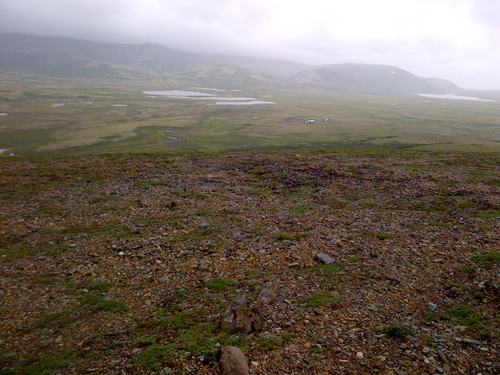
My day started with a 90 minute flight from Anchorage Alaska aboard a small twin engine plane bound for the remote village of Iliamna. Our route traversed the Alaska and Aleutian ranges and, for a portion of the journey, we flew through stream etched narrows flanked by craggy mountain peaks. The view was riveting. I was mesmerized by the expanse of completely untouched landscape with no signs of human activity for as far as I could see. It was a truly unusual sight for me coming from a region of the country where pristine landscapes are a thing of the past and every acre of land bears evidence of human habitation in the form of roads, bill boards, houses and other infrastructure.
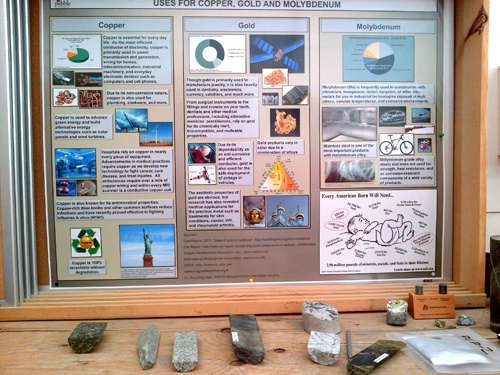
As we flew across the mountains, streams, and small alpine lakes I thought about the uniqueness and value of this land as an undeveloped natural area. I also thought about the purpose of our visit to Iliamna. We were on our way to one of the world's largest porphyry copper deposits that, when developed into a mine, will provide a much needed economic base for the state of Alaska. Not only will the mine provide copper and gold ore to an ever growing market but it will also mean development of an environmentally unique and sensitive area that feeds two watersheds, borders several national and state parks as well as a wildlife refuge. Because of its location the project is controversial and there is a well funded opposition movement that has molded public opinion through television ads and other avenues.
At present about 50% of the local community is against the mine. The Pebble Mine is a lightning rod for the broader land use debate and clearly highlights the central questions that must be answered if mining here is going to be accepted by the general public. So what are the central questions? The first and foremost question is can minerals be extracted in a way that only temporarily alters the land and has no long term deleterious effects? Can the mine and tailings impoundment be designed to minimize risk to fragile ecosystems around the mine including salmon habitat in Bristol Bay? What are the socioeconomic consequences of choosing not to mine at Pebble? If we don't mine here where will our Cu come from and at what tangible and intangible costs?
These are difficult questions that aren't easily answered. This is because there are many different points of view and constraints that must be considered and compromise will inevitably be required. Each stakeholder has their own needs, experiences, and values. Somehow we must take these disparate views and make a decision for the collective good which is no easy task. The decision must be based on science. That is the challenge and my visit to Pebble underscored the urgency and necessity of tackling these issues. They aren't going to go away.
After our visit I feel confident that the Pebble mine will be designed and operated to the highest environmental standards using sound science and engineering. The owners are investing significant resources ($60 million this year alone) in environmental baseline studies and impact assessments. At least 17 local, state, and federal agencies are involved in the permitting process and twice as many third party contractors are on the ground managing the environmental aspects of the project.
Pebble has garnered national, even international attention and much is at stake. In the end it is about managing risk and managing public perception. We have the technology to manage risk. It is much more difficult to manage public opinion and much of that debate will take place in court rooms and Congress.